
Introduction to supplier relationship management
Supplier Relationship Management (SRM) aims to build a collaborative and long-term partnership with suppliers, where you both benefit from less cost, optimised delivery, and more resilience against potential risks to supply.
The tools and templates on this page will help build this partnership. A successful SRM strategy often needs a business change and senior stakeholder endorsement.
For advice on this or any other aspects of SRM, email us.
The Supplier Relationship Management wheel
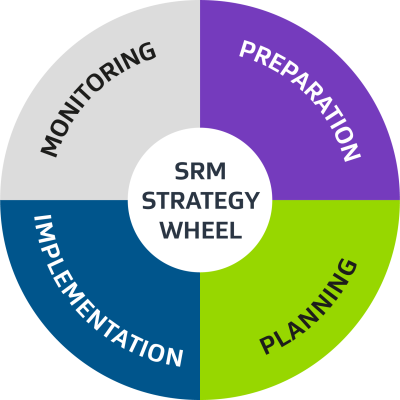
SRM strategies/plans can look different for every supplier or tier of suppliers, depending on your organisation.
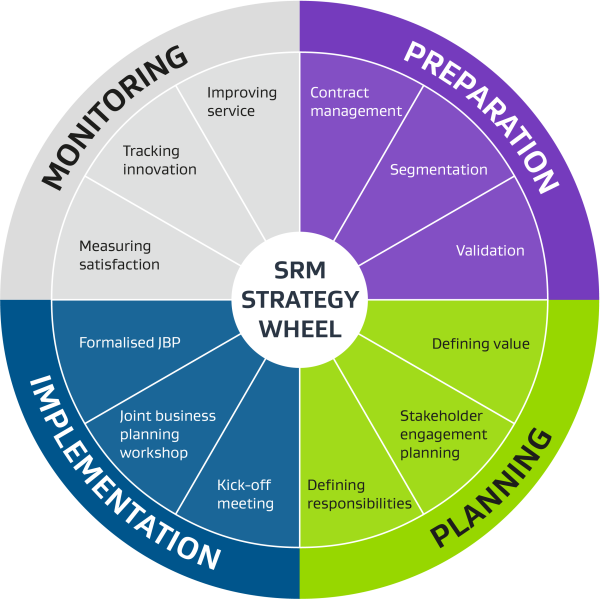
This page gives you an overall view of a complete SRM strategy, with tools and templates for each of these steps.
Preparation phase
In the preparation phase you'll gather relevant documents and data. This will help identify the suppliers where SRM would be most valuable. The preparation phase has 3 steps, highlighted in purple in the wheel below.
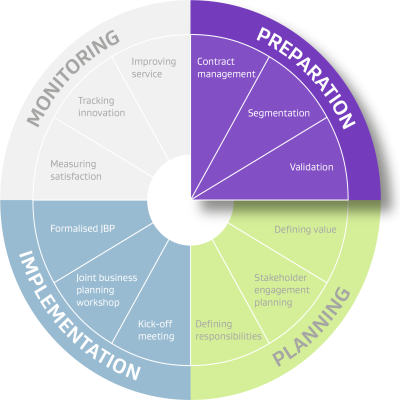
1.1 Contract management
A contract register is essential for effective contract management, and contract management is essential for an SRM strategy. You risk losing visibility and control over key agreements without a clear view of each contract, their scope, who is involved, and their deliverables. This lack of oversight makes it difficult to:
- manage costs
- assess supplier performance
- ensure compliance.
A well-maintained contract register gives you a foundation of efficiency, accountability, and strategic planning, both for SRM and broader business operations.
1.2 Segmentation
For organisations with a large supplier base, segmentation is a two-step process:
- segmenting the categories of suppliers
- segmenting the suppliers within those identified categories. You’ll map suppliers/providers into a matrix to prioritise who to build relationships with.
If your smaller organisation has a clear view of the categories that your suppliers fall into, and a smaller supplier base, you may not need to segment by category first. You may find the Lite segmentation tool useful instead.
1.3 Validation
In the validation step, you should:
- Validate your segmentation results with the appropriate internal stakeholders. Their feedback may change the segmentation results. You could do this by holding a meeting to discuss your thinking and approach so far.
- After making any changes, document the final results of the segmentation.
- Get written approval to proceed with an SRM strategy for the identified suppliers or providers.
Planning phase
This phase of the SRM strategy defines the value you expect to get from managing the relationship with specific suppliers. Knowing the expected value helps you decide how often to engage with suppliers and who will be responsible for the different project activities.
There is no one-size-fits-all approach and plans should be appropriate for the tier of the supplier. Tier 4 suppliers won’t require the same level of engagement as tier 1 suppliers.
The planning phase has 3 steps, highlighted in green in the wheel below.
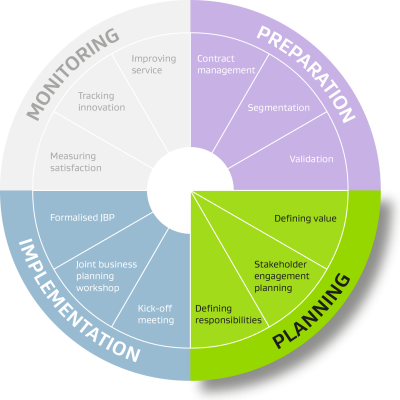
2.1 Defining value
Think about how SRM will bring you value. This helps speed up the process because you know what you are working towards and how long it might take. It also helps you get support for the SRM project from other stakeholders. This is a key step for identifying what outcomes you want from the project.
2.2 Stakeholder engagement planning
Good stakeholder engagement comes from stakeholder analysis and a well-informed communications plan. This step sets expectations for how the SRM project will be supported, both internally and externally. An effective communications strategy can help maximise this support.
2.3 Defining responsibilities
Once you understand stakeholders’ expectations, the next step is to clarify roles and responsibilities. Create a plan of who does what in the SRM project by drafting a high-level RACI chart. RACI stands for Responsible, Accountable, Consulted, and Informed.
You'll present this to stakeholders later. They should agree to it as part of the implementation phase.
Implementation phase
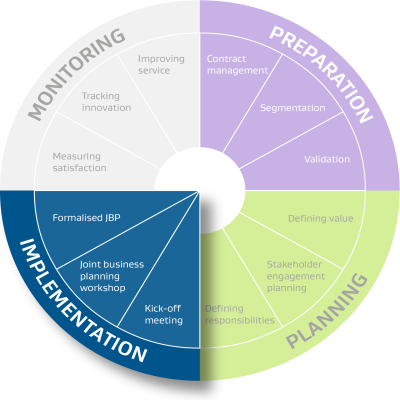
This phase of the SRM strategy puts the whole project into action. You'll start the planned external engagements with suppliers and formalise the Joint Business Plan, which guides the ongoing relationship.
The Implementation phase has 3 steps, highlighted in blue in the wheel below.
3.1 The kick-off meeting
After segmentation and planning, your internal SRM project group should have some ideas for projects you can start with suppliers. Use a kick-off meeting to get support for these project ideas from suppliers or providers. This template gives you a structured agenda for kick-off meetings.
3.2 and 3.3 A joint business planning workshop and the JBP
A joint business planning workshop, led by project leads from both your organisation and the provider/supplier, will help you finalise a formal Joint Business Plan (JBP). The purpose of the workshop is to communicate strategic goals for the project and brainstorm where the two organisations can align. From here, you can draft and sign a JBP. The JBP informs the working relationship moving forward.
Monitoring phase
This phase of the SRM strategy monitors the relationship you have established with the supplier by tracking the satisfaction on both sides. The activities you choose in this phase will depend on how the relationship is performing. If it's going well, you can start to look for innovation. If it's under-performing, you can choose a service improvement plan instead.
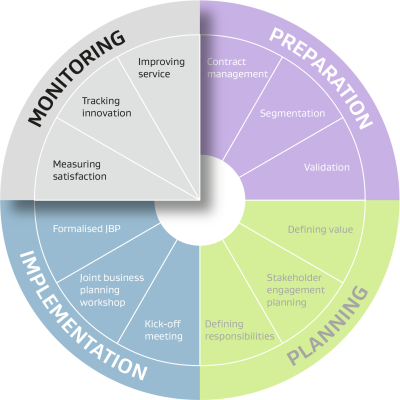
Once the SRM strategy is in place with a supplier/provider, it's a good idea to measure how the relationship is performing. Complete this scorecard collaboratively with the supplier or provider to get a balanced picture of satisfaction.
You can start to look for innovation after following a formalised JBP and measuring satisfaction on the balanced scorecard. Innovation tracking lets you capture ideas, evaluate their value, identify risks and plan an implementation approach.
If the supplier or provider is not meeting the expected delivery standard despite implementing an SRM strategy, you can use the Service Improvement Plan template to describe and monitor improved performance expectations.
The complete Supplier Relationship Management wheel