

Roles and responsibilities
Each participant in an All-of-Government contract has responsibilities that they must meet.
The participants in an All-of-Government contract
Most commercial arrangements have 2 participants:
- the buyer
- the supplier or provider of the goods or services.
The buyer contracts directly with the supplier or provider.
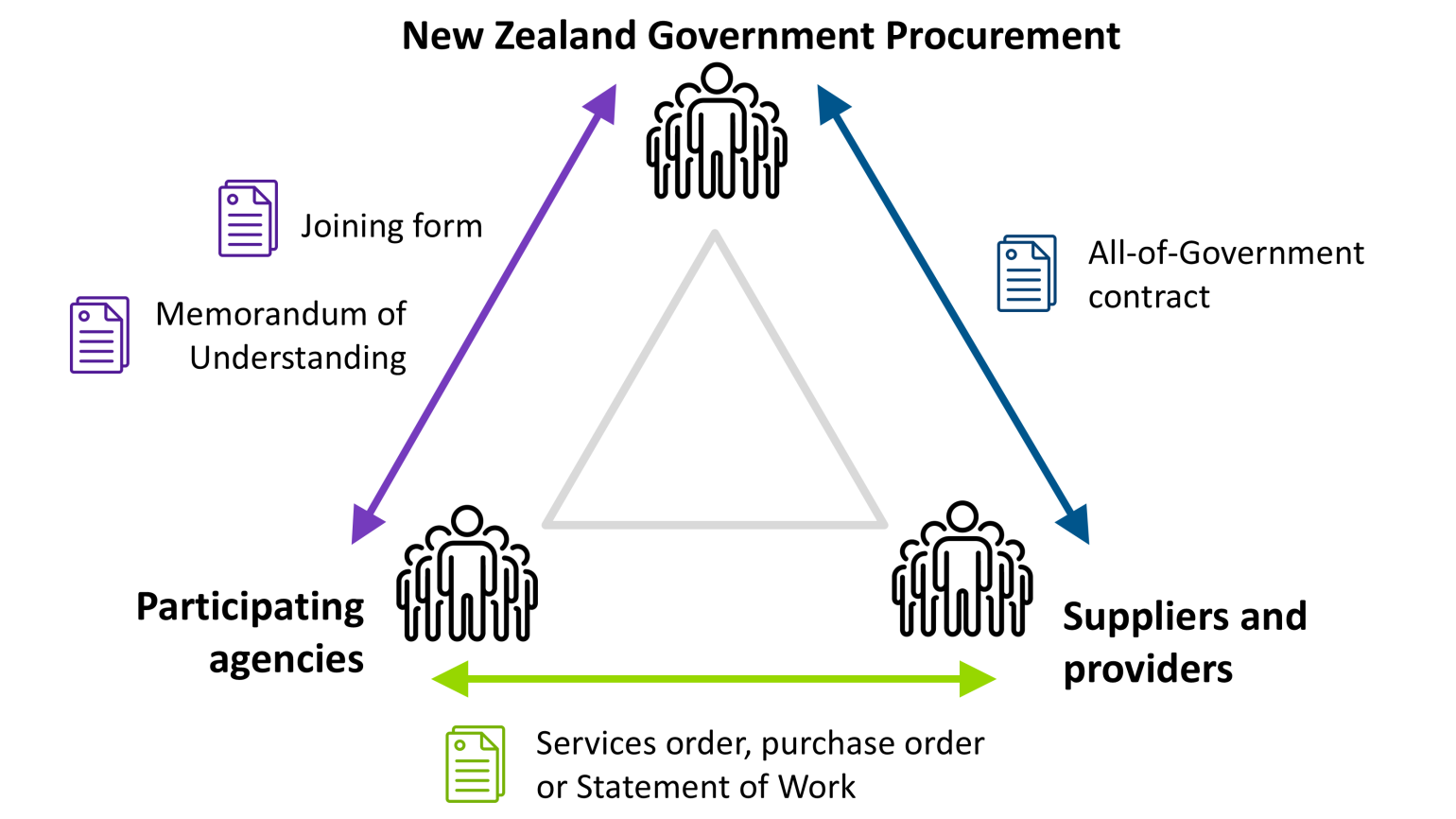
There are 3 participants in All-of-Government (AoG) contracts:
- New Zealand Government Procurement (NZGP), who establishes and manages the contracts
- the buyer (an eligible government agency)
- the suppliers or providers of the goods or services.
Common capability contracts
Common Capability (CC) contracts work the same way as AoG contracts, but aren't owned by NZGP. They’re owned by the Government Digital Delivery Agency or the Government Property Office.
The responsibilities described on this page also apply to the participants in Common Capability contracts owned by the Government Property Office.
One syndicated contract, 'Document storage, digitisation and destruction services', also has similar roles and responsibilities as described on this page.
For each AoG contract, NZGP negotiates favourable rates and conditions for all eligible agencies. Eligible agencies include the schools, Crown Research Institutes, and Crown Entity subsidiaries listed on the Mandated and eligible agencies page.
Mandated and eligible agencies
These favourable rates and conditions are set out in contracts with the chosen suppliers or providers.
To use an AoG contract, an eligible agency must complete a joining form. The joining form confirms that they agree to the terms set out in a Memorandum of Understanding (MoU) with NZGP. This makes the agency a ‘participating agency’ in the contract.
The agency then uses a separate document (like a services order or statement of work) to purchase goods or services from the supplier. Templates for these documents are available on the webpage for each contract, for logged-in users. The terms of the AoG contract still apply.
Participating agencies’ responsibilities as the buyer
Participating government agencies and schools maintain the day-to-day operational relationship with their chosen supplier. Their responsibilities include:
- fulfilling obligations set out in the AoG contract
- fulfilling obligations set out in the services order, purchase order, statement of work, or equivalent document
- keeping commercially sensitive information secure, in line with the Non-Disclosure Agreement
- managing the operational relationship with a supplier
- notifying suppliers of any internal policy, security clearances and probity checks that the agency needs for compliance
- managing suppliers' performance
- escalating any disputes or other issues, in line with the dispute resolution process in the AoG contract
- working with suppliers to agree any specific reporting requirements, like monthly spend or service levels. This should also be recorded in the services order, purchase order, statement of work or equivalent document.
Protective security requirements for participating agencies
All public sector agencies are encouraged to follow the government’s Protective Security Requirements, including the New Zealand Information Security Manual (the NZISM). Some agencies are required to follow these.
This means agencies need to consider how suppliers are collecting, storing and using their organisation’s information. An agency’s information could also be used by a third party, like a supplier’s subcontractor or software platform provider.
New Zealand Government Procurement’s responsibilities as the contract manager
NZGP negotiates and enters into AoG contracts with suppliers. They then manage these contracts.
The responsibilities of the contract manager include:
- monitoring suppliers' performance against agreed service levels
- managing supplier audits
- managing the strategic relationship with suppliers
- managing any disputes escalated by agencies or schools
- managing changes to AoG contracts, including extensions and renewals.
Supplier responsibilities
AoG contract suppliers and providers should:
- provide services or products to participating agencies and schools in accordance with the requirements of their services orders and the AoG contract, including any agreed service levels
- inform agencies and schools of how they will collect and use their information, including third party access
- provide any transition services that agencies and schools need to move from an existing agreement to an AoG contract
- submit reporting as required by the AoG contract and an agency’s services order (or similar)
- provide account management services to participating agencies and schools
- meet any contract management requirements in the contract, like notifying buyers of business changes or issues impacting services
- promote the AoG contract to other eligible agencies and schools.
Resolving disputes
Suppliers or providers, and agencies or schools, must try to resolve any disputes that arise between them as soon as possible. They must follow the dispute resolution process included in the AoG contract.
If a dispute isn't resolved within 10 business days, the agency and the supplier must escalate it within their organisations, in line with the escalation steps in the contract.
If it's still not resolved after 30 business days, the dispute must be escalated to NZGP’s Head of Collaborative Procurement and the supplier’s Chief Executive or equivalent.
Email us for advice on any disputes or issues that arise with suppliers.
Contract documents
The following contractual documents apply to AoG contracts.
All-of-Government (AoG) contract
This is sometimes also called a ‘Master Services Agreement’, ‘Master Supply Agreement’, or MSA.
The AoG contract sets out terms for a supplier to offer goods or services, and terms for participating agencies to buy those goods or services. It also sets out the contract management responsibilities of NZGP as part of the Ministry of Business, Innovation and Employment (MBIE).
It’s signed by MBIE and each supplier.
Non-Disclosure Agreement (NDA)
This is signed once by an eligible government agency or school to give them access to the contract documents for all AoG contracts, including commercially sensitive information (like supplier pricing).
Memorandum of Understanding (MoU)
Sets out the relationship between NZGP and the participating agencies. It describes the obligations of each party and the key terms in the AoG contract that relate to participating agencies.
A copy is available on each contract’s webpage for logged-in users.
Eligible agencies and schools agree to the terms of the MoU by completing a joining form.
Joining form
This is sometimes called a ‘Letter of Accession’ or LoA.
By completing the joining form, an eligible agency or school agrees to comply with the MoU and becomes a participating agency in the AoG contract.
The joining form for each AoG contract is usually available on that contract’s webpage.
Statement of Work (SoW)/Purchase or Services Order/Pricing or Service Supplement
Agencies or schools will use one of these types of documents (or an equivalent) to buy goods or services from a supplier under an AoG contract. It’s signed by the participating agency or school and their chosen supplier or provider.
Templates for these, if applicable, are usually available on the AoG contract webpages for logged-in users.