

Unearthing our environment’s hidden stories with procurement
Earth Sciences New Zealand (ESNZ) imported a stable isotope ratio mass spectrometer that will provide faster in-house analysis for scientists.
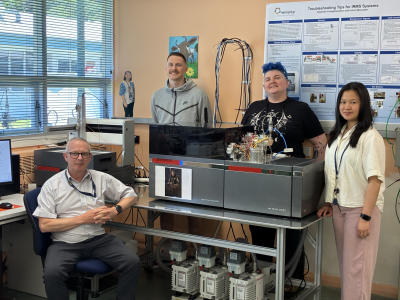
Left to right: Andy Phillips, Joanna Yang, Tyler Heath, Rebekah Hines and Phoebe Tio of Earth Sciences New Zealand. Photo: Supplied.
New equipment that supports everything from groundwater tracing to volcanic hazard monitoring has arrived in the country.
Earth Sciences New Zealand (ESNZ) imported a stable isotope ratio mass spectrometer (IRMS).
Earth Sciences' lead operator for the Stable Isotopes Laboratory Andy Phillips said an IRMS helps people understand the hidden stories of water, volcanic gases, or even the origins of methane deep underground.
"ESNZ secured one of the most advanced models in the world, to ensure continuity, adaptability, and precision for many years to come.
"It strengthens our ability to deliver world-class research, provide safety agencies with information they need to help safeguard the public, and explore the hidden stories written in the chemistry of our planet."
The procurement team worked closely with the Stable Isotopes Laboratory, part of the national hub for isotope science at Gracefield, to draw up a procurement plan to source the IRMS from the UK. Together they assessed procurement risks, the requirements and deliverables, and timeline for the project.
It was an interesting project to be part of, said Sophie Crooks, senior procurement specialist.
"I enjoyed capturing all the elements negotiated with the supplier into the contract and liaising with the legal team to ensure everything was clearly described and precise."
"Procuring this type of equipment involves a highly technical context. Liaising closely with the project lead to define precise requirements and deliverables is essential. Additionally, engaging all relevant business stakeholders such as the Facilities Team helps ensure the chosen location is suitable and that adequate utilities are in place for the equipment."
ESNZ has also projected some economic benefits of the IRMS.
"The capabilities of the new equipment will help us with new projects, and it will absorb work from our older instruments as their reliability diminishes."
And there are wider benefits for the public.
The IRMS will provide faster in-house analysis which means scientists can respond quickly to volcanic gas alerts, providing timely scientific advice to the Department of Conservation and other agencies. Emergency response and other public safety agencies make use of this information to help keep communities safe. It also helps preserve critical expertise within New Zealand.
"Reliability is non-negotiable for a lab that underpins critical research that informs decisions made by national safety agencies, and commercial delivery to local and global customers."