

Procuring Christmas in a box
What does it take to get items from home, treats at Christmas time, to soldiers working in tough conditions? Coordination, negotiation, and supplier relationships.
Being deployed overseas on peace keeping missions during Christmas can be hard for New Zealand’s Defence Force personnel.
The Royal New Zealand Returned and Services' Association (RNZRSA) understands this.
For 85 years the veteran support charity has sent Christmas parcels filled with goodies abroad to military personnel serving in some of the world’s most hostile conditions.
Procurement plays an important logistical role in connecting service personnel with these cardboard parcels from home.
This story focuses on the journey of the cardboard box, where it’s sourced from and how it is made. The box carries small reminders of New Zealand to some of the country’s hardest working representatives.
The RNZRSA's Communications and Marketing Manager, Rachel Riley, took part in this year's 'packing event' held in Trentham, Wellington.
"It's a great project to be part of. A bunch of RNZRSA National Office staff, members of the NZDF and our broader community all come together and packed cardboard boxes with food and supplies for those deployed overseas."
Rachel Riley RNZRSA's Communications and Marketing Manager
The procurement of a product that has to go through some pretty rough conditions, while also containing items people are looking forward to is important, Ms Riley says.
"We need something we know is going to hold what we need, weather the storm of international shipping, and that is affordable. It has to be robust.
"The RNZRSA is incredibly grateful to Wellington company Packaging Product Production Limited who produce and donate the cardboard boxes for the project."
The company has been involved in the RNZRSA's Forces Christmas Parcel Project for 6 years.
Packaging Products General Manager Craig Deadman said it was a privilege for his team to be part of the project.
"It's great to be part of a bigger project with other very well-known business and organisations like the RNZRSA.
"It's really great to be involved in a feel-good project and to give something back to the community that has supported our business."
The company has about 10 people working on the project. And on packing day everyone who is able to comes in to take part.
"Everyone is there for the right reasons."
The Christmas parcels leaving New Zealand are 2 cardboard boxes in 1.
"It has to be durable, and it has to hold its shape without damaging the products inside. That’s the last thing we want."
The cardboard boxes are sourced from 2 main cardboard suppliers, both local New Zealand companies. They're purchased monthly with a lead-time of about 2 weeks.
The completed cardboard box is a mixture of an inner 'stock box' sourced from a large box maker in Levin, plus an outer box which is manufactured and printed at the company’s Lower Hutt Factory.
Packaging Products Production General Manager Lincoln Hart said there were challenges in the project, but they were overcome and turned into opportunities thanks to the company’s niche production capabilities.
Each year the order number for boxes changes depending on how many service personnel are deployed overseas. This means there isn't always the option to do a bulk order.
"The cardboard suppliers have minimum order quantities (and lead-times) when we purchase material cut-to-size for specific jobs. So, for short run orders we cut the required material from large size sheets of cardboard which we carry in stock, enabling a quick turnaround."
The firm uses in-house digital printing capabilities to print the RSA boxes and can have them branded with different artwork each year.
127 cardboard boxes for deployed military personnel were made.
This year, the Christmas parcels are heading to countries and regions including South Sudan, Egypt, and the wider South Pacific.
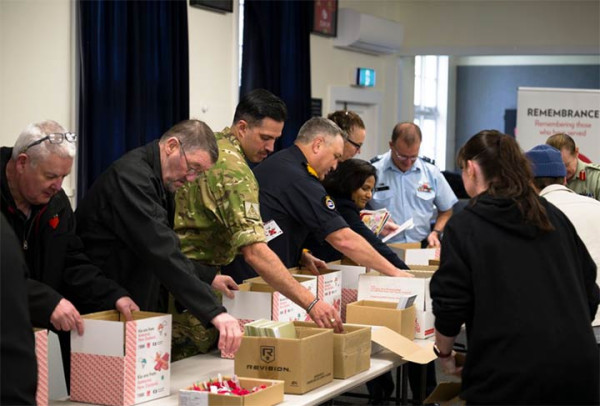
Members of the Defence Forces and the community take part in a packing night of gifts for soldiers deployed overseas. PHOTO: New Zealand Defence Force