

Procurement with a 120-year specification: how the NZSO sourced the perfect Mahler hammer
When most procurement projects begin, the challenge is defining the outcome. For the New Zealand Symphony Orchestra (NZSO), the outcome was already defined – by a composer who died more than a century ago.
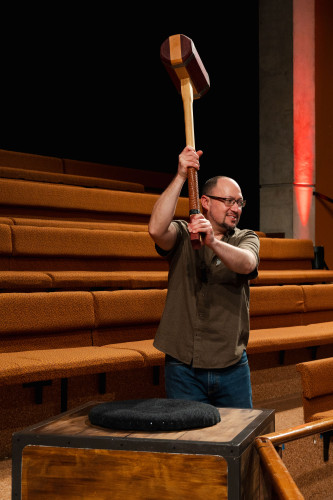
New Zealand Symphony Orchestra principal percussionist Lenny Sakofsky, ready to strike. Image credit: NZSO/Phoebe Cassidy.
Preparing for a 2025 performance of Gustav Mahler's monumental Symphony No. 6, the orchestra faced an unusual sourcing challenge: finding a way to recreate 1 of classical music's most famous sound effects, the devastating "Mahler hammer" blow that punctuates the symphony’s final movement.
Mahler was remarkably specific about what he wanted. The hammer strike, representing the crushing blows of fate, needed to be "brief and mighty, but dull in resonance and with a non-metallic character (like the fall of an axe)." For 120 years, orchestras around the world have searched for the perfect way to deliver to these specifications.
NZSO's principal percussionist Lenny Sakofsky was responsible for delivering the perfect hammer blow.
"In the percussion section, you’re always hunting for quirky instruments," he says. "As principal percussionist, it’s my job to go find the instruments to do the job."
While many procurement exercises involve choosing between available products, the Mahler hammer and box presented a different problem. There was no off-the-shelf solution.
The NZSO had performed Mahler's Sixth before, but previous attempts at the hammer strike had fallen short. Without an adequate box, an early effort reportedly resulted in a hammer strike that broke the floorboards of the Auckland Town Hall and still failed to create the desired effect.
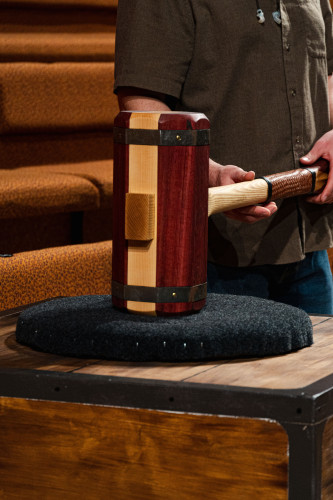
New Zealand Symphony Orchestra’s Mahler hammer and box. Image credit: NZSO/Phoebe Cassidy.
"It's supposed to be climactic, heard above the orchestra, but we didn’t even notice the sound of the floorboards breaking," Lenny recalls.
Unlike many procurement exercises, there was no catalogue to browse and no local supplier market specialising in Mahler hammers and boxes. Thanks to online resources, the NZSO team could study examples from overseas and better understand what had worked elsewhere.
Renting and shipping a specialist instrument from Europe was difficult to justify for a piece performed only occasionally. So instead, the orchestra turned to an increasingly valuable resource: the skills already sitting inside the organisation.
Lenny approached double bassist Malcolm Struthers, a long-serving NZSO musician with a parallel career in instrument making and repair.
"I talked to Lenny and said, 'I think I can do that," says Malcolm.
The project quickly evolved into a collaboration between musicians and production staff.
Malcolm was confident he could construct the box, but the hammer itself required additional expertise. Another orchestra colleague, also an accomplished craftsman, joined the effort to create an instrument that was both functional and visually striking.
The resulting hammer resembled something from Norse mythology, crafted from ash and maple, banded with metal and finished with a leather-bound handle.
"We'd all seen the bloopers where the head flies off," Malcolm says. "So, it had to be robust."
The box required equal attention. Working with another colleague, Malcolm developed a design that would survive repeated blows of the hammer while producing the desired acoustic effect.
The team also considered aesthetics. If the hammer symbolised fate, what should the box look like?
Ideas included painting it as a giant dice, but they ultimately opted for a darker, more theatrical treatment. The box was stained to resemble an aged chest and fitted with a jagged sound hole at the front, symbolising fate escaping its constraints.
"We didn’t know how they would sound together until they were built," says Malcolm. "We were flying blind."
Like any procurement project, success ultimately depended on performance against requirements. Importantly, the box was not amplified. The sound had to work naturally against the force of a large symphony orchestra.
When the moment arrived during performances in September 2025, the verdict was immediate. The NZSO's Mahler hammer was reportedly described as "the best hammer sound ever".
Positioned above the orchestra and highlighted by a spotlight, the percussionist delivered the famous hammer blows with the impact Mahler had intended.
A lesson in creative procurement
The Mahler hammer project highlights a reality familiar to many procurement professionals. Not every requirement can be met through conventional procurement channels.
Sometimes the best solution lies in collaboration, ingenuity and thinking outside the box.
For the NZSO, the project also reflects the broader evolution of modern orchestras. As budgets tighten and repertoire becomes more diverse, musicians are increasingly called upon to apply skills beyond performance.
"The orchestra is becoming more diverse," says Malcolm. "You need a more diverse set of skills."
Those skills extend from craftsmanship and engineering to design and problem-solving – capabilities that enabled the NZSO to deliver to specifications first written more than a century ago.
The hammer and box are now safely stored for future performances, ready for the next time fate needs to deliver its mighty blow.