

New Dunedin Hospital job and skills hub – case study
NZGP has helped a government funded job and skills hub change its economic fortunes and improve its commercial operations.
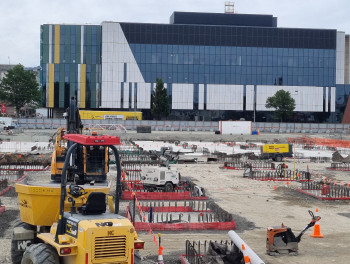
The foundations of the new Dunedin inpatients hospital with the newly built outpatients in the background. Photo: WFCD.
NZGP helped Workforce Central Dunedin (WFCD) to pivot from being solely reliant on government funding to broadening its revenue streams and drive towards business sustainability.
When the New Dunedin Hospital was first announced, a group of people and agencies recognised there was a risk Dunedin would not be able to supply the workforce needed for the hospital build. The group believed establishing a job and skills hub would go a long way to mitigating this.
In June 2020, the Kānoa – Regional Economic Development and Investment Unit (Kānoa), part of the Ministry of Business, Innovation and Employment (MBIE) provided the operational funding for WFCD, a jobs and skills hub to support the hospital build. Te Puni Kōkiri and the Ministry of Social Development (MSD) also provided some funding.
WFCD aimed to create local employment and training opportunities. They would address severe domestic shortages in construction and infrastructure workers.
The situation Workforce Central Dunedin (WFCD) found itself in
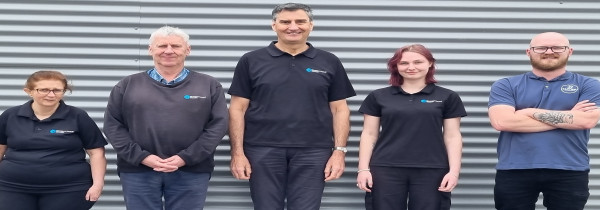
Left to right: The WFCD team Michella van Nugteren (cleaner), John Fitchett (MSD work broker seconded to WFCD), Raymond Clark (operations manager), Beth Ardouin (community engagement coordinator) and Fletcher Kaan (Mates in Construction field officer). Photo: WFCD.
WFCD saw the new Dunedin Hospital Outpatients build as an ideal launch pad. The ethos of the Health NZ’s project was to maximise economic benefits. That meant jobs and training advancement for the whole Dunedin community.
As with many large long term construction projects, it was constantly challenged by unforeseen circumstances. The timing could not have been worse at the onset of COVID-19 which shifted central funding priorities and caused delays for contracts and packages of contracts being awarded. Contractors were under pressure to get the work done against shifting timeframes. This meant training and/or filling jobs with WFCD jobseekers, and the commitment to utilise WFCD, was often passed over for quicker solutions such as short-term labour hire.
WFCD’s operations manager Raymond Clark said the construction delays and COVID-19 made it difficult to achieve project outcomes and the hub was fast running out of placement options for job seekers.
“Now that our MBIE contract has come to an end, we realised we were solely reliant on government contracts, and this could not sustain us beyond MBIE’s initial funding.”
WFCD asked for help through MBIE and were given access to the commercial engine room of NZGP, the Advisory and Business Services team.
Raymond met Dr Jas Qadir, a Commercial Leader at NZGP. Jas specialises in regional development and social investment / procurement workstreams within the Advisory and Business Services team at NZGP.
The process was to help WFCD better understand how the Job & Skills Hub could reposition itself commercially and drive towards multiple revenue streams.
Next steps – building a commercial future
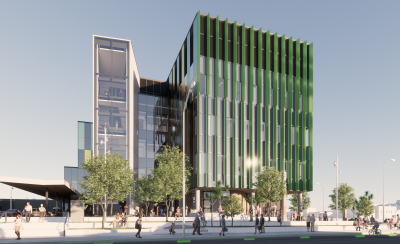
An artist's impression of the new Dunedin Hospital Outpatients once completed. Picture: WFCD.
Raymond said connecting with Jas and NZGP through Kānoa was life changing for his hub.
“Jas was very interested in our hub and the things we had achieved. He advised that seeking funding was not the only thing to consider. He showed us that what we are doing had commercial value and we should be charging for it.
“At the start, we were dubious because we felt since contractors got service from us free, why would they pay.
“Jas gave us the commercial and business models to think about and business plans to complete. The conversations with Jas, and us seeing ourselves for the first time through the eyes of a commercial expert transformed our self-belief and our operations.”
This led to discussions with WFCD’s parent organisation Business South. Business South then opened the door to WFCD to leverage off their resources.
“Options have really opened up. Business South now include us as a referral agency for businesses who pay for our workforce development services.”
“We never saw these opportunities before Jas, NZGP, and Kānoa helped us. It’s empowering to now think differently and foster new exciting initiatives which may form a revenue stream.”
With NZGP’s continued guidance and advice WFCD is now building a strategic funding roadmap that will leverage a mix of government, industry, and self-funded revenue streams.
“This funding diversity gives us strength because the future was previously uncertain,” said Raymond.
The future
WFCD plans to become independent of government funding in stages. MBIE’s funding ends December 2025 – another agency’s support finishes in 2027. After that, WFCD will rely on Dunedin Hospital work until 2031.
“Beyond that, Business South gives us hope and a plan for post-hospital work,” says Raymond.
“Financial independence will help our people get jobs. We’ll strengthen systems and processes, which benefits the community.”
WFCD’s work in Otago included expanding its services beyond construction into other sectors facing workforce shortages. WFCD intends leveraging its reputation and partnerships to become a trusted employment and training hub for Otago and beyond.
Advice for others who may be facing uncertain financial futures
Ask for help, says Raymond.
“Ask for it today. Given the experience I have had with Kānoa and NZGP, I would 100% recommend they ask for help today. Start with Kānoa and NZGP, and go from there.”
Developing a growth mindset is important, listen to what others are saying, and appreciate that people like Jas and the team at Kānoa support your project and want it to succeed.
“They saw value that I didn’t always see.”
“My big lesson was to get my head out from within the trenches and appreciate what else was happening in the wider world.”
Key outcomes
WFCD delivers significant economic benefits for Otago and New Zealand:
- Employment placements and training for work readiness.
- Upskilling of people already employed.
- Connecting local businesses to contractors on the new Dunedin Hospital site.
- Improving productivity through coordinated on-site training.
- Negotiating to get discounts on worker training.
WFCD’s success demonstrates how government-funded initiatives can evolve into commercially sustainable models, ensuring long-term benefits for communities.
Important facts
- WFCD delivers several economic benefits for the Otago region and the country. They include employment, training for employment, upskilling of people employed on the hospital site, pastoral care of workers on site, connecting local businesses to contractors on the site, improving productivity by coordinating on-site training across the various contractors, and negotiating discounts for full courses.
- NZGP's Advisory and Business Services tīma is always available to support government agencies with business and commercial needs. Simple requests can often be handled in short order, but they’re also here if agencies have a challenging situation.