

Lifting people up and giving them a "why" brings in awards
A partnership approach in a new procurement programme has led to positive engagement by prisoners and a reason to take part in their immediate communities.
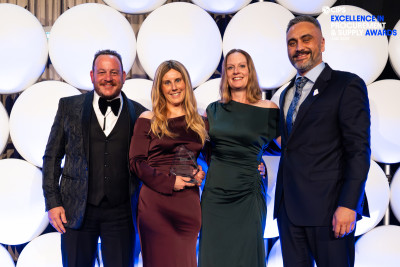
Left to right: Tod Cooper, Emma Morrow, Charlotte Payne, and Conan Manaena at the awards night that saw The Ara Poutama Aotearoa, Department of Corrections procurement team win the Best Collaborative Teamwork Project and Project of the Year at the awards. Photo: Supplied.
Putting people first in the design of a complex procurement programme landed two of the biggest procurement prizes available in the Southern Hemisphere.
The Department of Corrections, Ara Poutama Aotearoa procurement team won the Best Collaborative Teamwork Project and Project of the Year for their Tikanga Māori Motivational Programme at the CIPS Excellence in Procurement and Supply Awards. The awards were held in Brisbane on 31 July.
Emma Morrow, Corrections Manager Commissioning for Outcomes, was incredibly proud of her team.
“Absolutely wonderful. A huge effort. The customer was the focus. It was about making sure people were connected as much as possible with a service that could lift them up and deliver positive outcomes.”
The Tikanga Māori Motivational Programme (TMMP) is about connecting people and helping them ground themselves so they can contribute and take part in their prison sentences constructively.
“TMMP motivates participants to change their behaviour through understanding their cultural identity and encouraging them to embody the tikanga of their tīpuna,” said Emma.
“Feedback from those in the management of Corrections has been positive. They are connecting with this programme in a constructive way making it easier for them to start the other requirements of their sentences.
“For some of the people this is the first time they’ve found their ‘why’. And this is leading to a more engaged group going through the Corrections settings. They’re finding their reasons to take part in the wider community.”
TMMP was last procured in 2016 through open competitive procurement.
The 2016 national tender approach contributed to some issues in the contracts, like providers delivering services in regions where they had no local relationships.
Emma said the primary objectives of the procurement project were to remove barriers from mana whenua to deliver their own tikanga and onboard providers who could work with both Corrections and their local iwi/hāpu to provide the best programme possible to the people who are managed by Corrections.
“Our aim for this new procurement was to deliver a new approach that would empower iwi and hapū to make decisions about the delivery of their own tikanga.”
In total, 66 iwi, hapū, or iwi alliance groups were consulted across 60 delivery sites.
The procurement strategy for TMMP was developed during a meeting that included the national procurement team, the regional contract management function, and the Māori strategy team.
“The approach agreed to was for regional teams to engage local iwi and hapū first to understand how they would like to be involved in the procurement or delivery of TMMP. This engagement would give iwi and hapū a high level of influence over the process we would follow and therefore the delivery of their tikanga.”
Emma said the procurement strategy represented a shift towards a relational approach to procurement that placed iwi and hapū at the centre of decision-making.
“In this way, it upholds the intent of Te Tiriti o Waitangi (The Treaty of Waitangi) and Hōkai Rangi, the organisational strategy of the Department of Corrections, Ara Poutama Aotearoa.”
Grace van Dyk, senior procurement advisor, said iwi and hapū were engaged by a nominated relationship holder for each site and presented with several options for their involvement.

Grace van Dyk with the two awards won at this year’s awards. Photo: Supplied.
“This included delivering the programme, participating in evaluating providers through a competitive tender, and being kept informed about the contract or provider performance.
Iwi and hapū were also encouraged to propose their own options if they had not already been identified.
Probity and conflict of interest were closely monitored and actively managed throughout all stages of the procurement process, including engagement, evaluation, and contract negotiation, to maintain fairness, transparency, and integrity.
A regional evaluation approach was then formed
Regional staff and iwi/hāpu representatives were asked to be involved in the evaluation processes for both direct sourcing and competitive procurement. This provided an opportunity to make sure that any concerns from any of the parties could be resolved prior to a contract being signed.
“For example, concerns were raised by an iwi representative panel member about a provider’s treatment of a local marae. This was able to be discussed in the presentations and moderation, and appropriate mitigations put in place that benefit the iwi, provider and keep the people in our management safe.”
Another key interest was how providers would include locally influenced direction in their teaching of tikanga Māori, said Grace.
“Inclusion of iwi/hāpu members on our evaluation panels means we have the people who are qualified to make this distinction and offer guidance to providers on their tikanga which the Department is not qualified to do.”