

Karen English on winning the Te Tohu Ratonga Tūmatanui public service medal
Karen talks about their life and journey into procurement and some of the toughest negotiation rooms in the world.
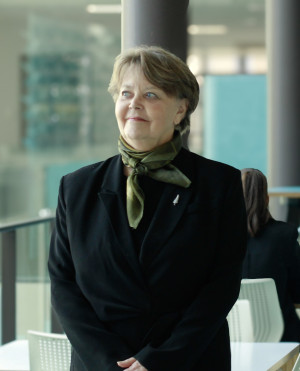
Karen English at MBIE’s office in Stout Street Wellington after winning Te Tohu Ratonga Tūmatanui – The New Zealand Public Service Medal. Photo: MBIE
Karen English recognised for her commitment to getting the best deal for New Zealand.
Karen English has been awarded Te Tohu Ratonga Tūmatanui – The New Zealand Public Service Medal, recognising her exceptional contributions to government procurement and international trade.
The medal is the top award given at Te Rā Ratonga Tūmatanui – The Public Service Day Awards which recognise individual public servants who demonstrate an outstanding commitment to New Zealand and New Zealanders.
Karen is New Zealand’s lead expert on government procurement and trade. She has led the negotiation of government procurement commitments in most of our free trade agreements.
She has represented Aotearoa New Zealand in the negotiation rooms of places like Saudia Arabia, India, and Canada, pulling trade agreements across the line that draw revenue into the country.
I don’t think I realised how amazing an award it was until I got to the ceremony where it finally hit home that it was such an honour. And there were all the other people who were nominated and they had done such amazing things. I'm pretty chuffed about the whole thing and I’m smiling a lot.
Karen English Director International Procurement
There were a wide range of emotions and feelings starting with, is this real? Have they made a mistake? What have I done to deserve this? It's amazing.

Karen English and husband Trevor at Wellington Zoo meeting a cheetah on their terms. Photo: Supplied
Her achievements include working on various iterations of the Government Procurement Rules. She’s negotiated almost all government procurement commitments in our free trade deals. She led New Zealand’s accession to the World Trade Organisation Agreement on Government Procurement. She led the first whole of government direction completed under new provisions in the Crown Entities Act. She also led on work with broader outcomes and embedding those into the Government Procurement Rules.
Her incredible life began on a small farm in Nova Scotia, Canada. Now she travels all over the world negotiating trade deals, going up against some very tough people in the process.
“Growing up on the farm I knew I didn’t want to do that forever. Farm kids everywhere will be able to identify with this. If you live on a farm, you are a resource.”
The child of immigrants to Canada, she was told to study hard and learn as much as possible, because no one can take away what you know. She took control of where she wanted her life to go, and chose law as her career path.
“As a baby lawyer you do everything. I did a bit of criminal law, family law, divorces. I ended up in litigation. The majority of my clients were in construction. It was always busy.”
After 20 years in law she decided she wanted something different, and moved to New Zealand due to a change in life circumstances.
“I didn’t know about procurement. I applied for a role in 2009 as a senior policy advisor in government procurement at MBIE’s predecessor, the Ministry of Economic Development.
“But I’m such a nerd. When I got the role, I made sure I attended all the seminars on offer, I attended the events and upskilled. Having a background in law was incredibly helpful.”
Through lucky timing, Karen arrived in the public service as New Zealand began to strengthen its international trade ties.
“It was when New Zealand started taking part in free trade agreements and wanted government procurement commitments in them.”
At this time her predecessor was retiring. Part of the handover included documents for the Trans Pacific Partnership Agreement, the APEC non-binding Principles of Government Procurement, the World Trade Organisation Agreement on Government Procurement, and the Mandatory Rules for Procurement by Departments.
“Over the Christmas holidays I read them. They were important to get through. Then when I got back to work I was asked if I’d like to go to Saudi Arabia to take part in a trade deal. I told my boss I didn’t know what to do and he said he didn’t either. An intense 5 months of training up happened, and I went.
“With my background as a lawyer and litigator I was well placed to negotiate.”
With each negotiation, Karen gained a greater understanding of what she was trying to achieve, what was happening on the international scene, and what could actually be done.
As time went on she increased her skills significantly, and became the country’s leading expert on procurement and trade.
She has now negotiated with highly experienced trade negotiators who represent countries across the Americas, Asia and Europe. Highlights include that very first trip to Saudi Arabia, then Peru, Chile, and South East Asia.
Each of the places the trade teams go experience different location challenges.
“The New Zealand government delegations are quite protected, and the host countries ensure people are safe.
“When you’re there you don’t have much time to go and explore and walk around. You arrive and prepare. Go to the negotiating venue. Once that finishes there may be a meal, but then it’s sleep before either returning to the table or going back to the airport.”
She has advice for people who go into negotiations.
“The word ‘tough’ can have various definitions depending on the circumstances.
“You need to figure out the positions your colleagues across the table from you are taking and their reasons for it. Sometimes they refuse to take a position so it’s difficult to get any traction. But listen. Don't shut the door even when situations get tough. Keep the communications going. Keep that door open. Find out what they want or find out what they don’t want. If you understand their reasons you might find a way to get what you want and what they want. Being curious helps.”
And understand your procurement system and theirs. Know how the machine works.
“I’ve run across negotiators and they don’t understand their procurement systems. They’ve been told this is what you have to ask for. This is what you have to reject. You have to unpick that so both parties can get what they want.”
Interesting facts:
- Karen’s help steering the country’s inclusion in the World Trade Organisation’s Agreement on Government Procurement led to NZ gaining access to over US$1.7 trillion in overseas government contracts across 48 WTO member countries.”
- Her work has also supported free trade agreements with the United Kingdom, the European Union, and the Comprehensive and Progressive Agreement for Trans-Pacific Partnership (CPTPP).
- She continues to contribute to emerging agreements as well as providing input to the continuing global evolution of procurement policy and practice.
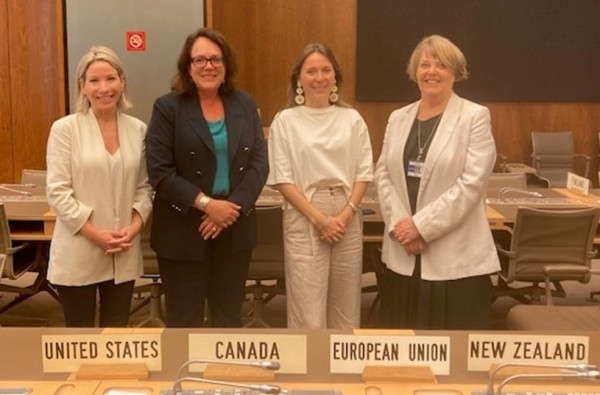
Karen at the World Trade Centre in Geneva at a meeting of the Government Procurement Committee in June, 2024. From left to right are Kate Psillos (United States), Nadine Nickner (Canada), Bogna Krysinska (European Union) and Karen English (New Zealand). They are the leads on the various work programmes of the Committee. Photo: Supplied