

Economic benefits case study: New fixed fluoroscopy system
The University of Canterbury is currently evaluating proposals for a new fixed fluoroscopy system. The new unit will replace an aging 10-year-old machine for the UC Rose Centre for Stroke Recovery and Research in Christchurch. The RFP asked potential suppliers to respond to all possible economic benefit categories.
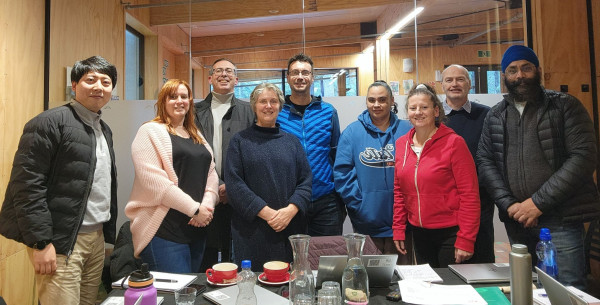
Sun Jeong (far left) with the Procurement team.
Sun Jeong, MCIPS, Te Ratonga Whiwhinga/ Procurement Business Partner says, “The new fixed fluoroscopy system is for the University of Canterbury’s (UC’s) Rose Centre for Stroke Recovery and Research. The Rose Centre is a state-of-the-art facility located in St Georges Medical Centre. They help stroke victims with swallowing and communication disorders.”
“In our tender documentation we were very conscious of Rule 8: Economic benefit to New Zealand. There is a specialised international market for a lot of medical equipment which means this aspect of the procurement has less potential for local economic benefits. What we have done though is to highlight the most relevant, local, economic benefits which relate to local servicing and support, training, knowledge transfer, research capability, innovation and sustainability. All these can be delivered by local suppliers, with a flow on into local economies. Making this clear in the documentation and on GETS has helped to make the criterion clearer and more practical for both suppliers and evaluators.”
For this tender, we are assessing the following areas:
Contribution to New Zealand businesses and supply chains
- Engagement of New Zealand-based distributors, service agents or subcontractors.
- Local presence for servicing, maintenance and support.
Skills, training and capability development
- Provision of training for UC staff and students.
- Knowledge transfer and capability building within New Zealand.
Innovation and sustainability
- Innovative features that enhance research capability or operational efficiency.
- Environmentally sustainable features and whole-of-life considerations.
"The new system will primarily support Videofluoroscopic Swallowing Studies for clinical assessment, research and teaching. Our ultimate aim is to use across these fields, with patients at the heart of it. Post-stroke, we want people to recover function or improve sufficiently to gain the best possible quality of life.” says Sun Jeong.
Rose Centre for Stroke Recovery and Research — University of Canterbury
University of Canterbury Fluoroscopy Tender — New Zealand Government Electronic Tenders Service (GETS)